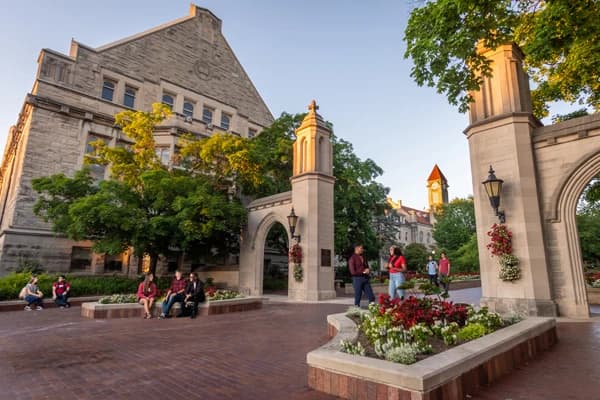

Indiana University-Bloomington
Overview
Indiana University-Bloomington is a public research university located in Bloomington, Indiana, and serves as the flagship campus of the Indiana University system. Founded in 1820, it offers a wide range of undergraduate, graduate, and professional programs across disciplines including business, law, public affairs, music, sciences, and the humanities. The campus is home to schools such as the Kelley School of Business, the Jacobs School of Music, and the O’Neill School of Public and Environmental Affairs. Indiana University-Bloomington attracts students seeking a comprehensive academic environment with strong research activity, Big Ten athletics, and a traditional residential college experience in a mid-sized Midwestern city.
Admission Requirements
With a 78.21% acceptance rate, Indiana University-Bloomington is moderately selective. Applicants are expected to show good academic performance and readiness for college-level coursework. Students with consistent grades, extracurricular involvement, and a well-prepared application are typically competitive for admission.
Cost & Financial Aid
History
Indiana University-Bloomington was founded in 1820 as the State Seminary by the Indiana General Assembly in Corydon, reflecting the state’s early commitment to public higher education. Classes began in 1825 in Bloomington, Indiana. In 1829, Andrew Wylie became the first president, and the institution was renamed Indiana College that same year before adopting the name Indiana University in 1838. The original campus was destroyed by fire in 1883, prompting relocation and expansion to its current site. During the late nineteenth and early twentieth centuries, Indiana University-Bloomington broadened its curriculum, introduced graduate study, and awarded its first doctoral degree in 1883. Under President Herman B Wells in the mid-twentieth century, the university expanded enrollment, academic programs, and campus facilities. Over time, Indiana University-Bloomington developed into the flagship campus of a statewide university system with a broad research mission.
Campus life
Gender
Race & ethnicity
Indiana University-Bloomington has a 18:1 student-to-faculty ratio, providing a balance between personalized instruction and a broader classroom environment. Students can expect opportunities to engage with professors while also benefiting from diverse perspectives in class discussions.
Applying to Indiana University-Bloomington with Unive
Applying to Indiana University-Bloomington involves submitting an application through the Common Application or Apply IU platform, along with transcripts, required test scores if applicable, and supporting materials. As the flagship public university in Bloomington, Indiana, Indiana University-Bloomington reviews applicants holistically, considering academic performance, coursework rigor, extracurricular involvement, and personal background. Some schools and programs may have additional requirements or selective admission standards.
Financial Aid at Indiana University-Bloomington
Indiana University-Bloomington offers financial aid through federal and state grants, scholarships, work-study programs, and student loans. Students complete the FAFSA to determine eligibility for need-based assistance. Merit-based scholarships and program-specific awards are also available at Indiana University-Bloomington, helping both in-state and out-of-state students manage tuition and living expenses.
Build a Stronger Application with Unive
Unive supports students applying to Indiana University-Bloomington by providing AI-powered guidance for college essays, extracurricular strategy, and overall application positioning. The platform also helps identify scholarship and financial aid opportunities tailored to each student’s profile. With structured feedback and planning tools, Unive enables applicants to present a clear, compelling application to Indiana University-Bloomington.
Ready to Apply to Indiana University-Bloomington?
Join thousands of students using Unive to craft standout applications for their dream schools.
Add to My College List


Is the information about Indiana University-Bloomington accurate and helpful?