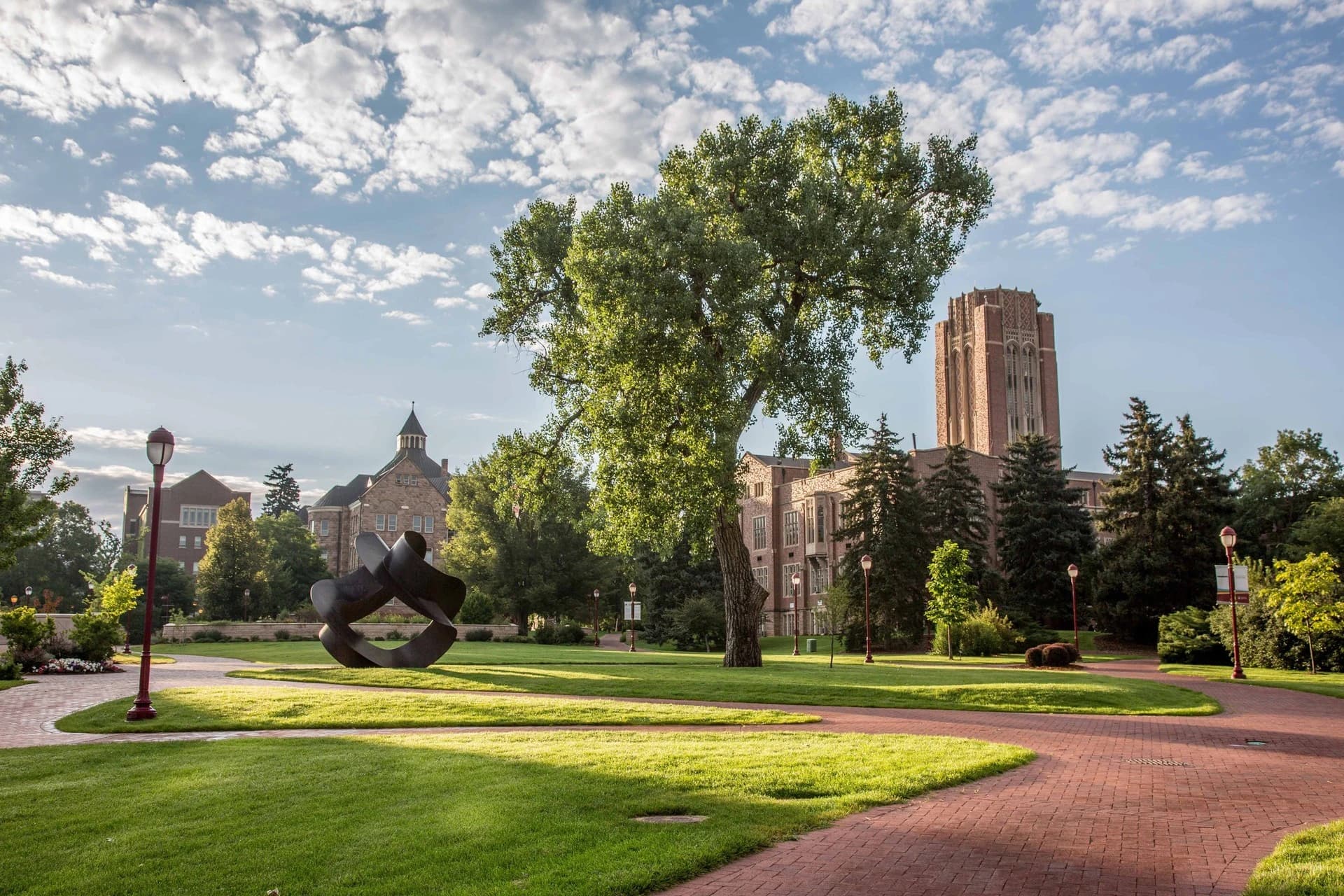

University of Denver
Overview
University of Denver is a private research university located in Denver, Colorado. Founded in 1864 as the Colorado Seminary, it is the oldest private university in the Rocky Mountain region. The university offers undergraduate, graduate, and professional programs across disciplines including business, law, international studies, engineering, social sciences, and the arts. Classified as an R1 doctoral university with very high research activity, it combines a residential campus experience with extensive graduate and professional education. Students are drawn to University of Denver for its urban location, strong study abroad participation, and programs in international affairs, business, and public policy, along with access to the cultural and economic opportunities of the Denver metropolitan area.
Admission Requirements
With a 77.81% acceptance rate, University of Denver is moderately selective. Applicants are expected to show good academic performance and readiness for college-level coursework. Students with consistent grades, extracurricular involvement, and a well-prepared application are typically competitive for admission.
Cost & Financial Aid
History
University of Denver was founded in 1864 as the Colorado Seminary by John Evans, then governor of the Colorado Territory. Established in the frontier city of Denver, the institution was originally affiliated with the Methodist Episcopal Church but operated as a nonsectarian school. In 1880, the Colorado Seminary was renamed the University of Denver, and David Hastings Moore became its first chancellor, helping organize the growing university. During the late nineteenth century, the campus relocated south of downtown Denver to land donated by Rufus Clark, where many historic buildings were constructed. University of Denver expanded its academic offerings in the early twentieth century and saw significant enrollment growth after World War II due to the GI Bill. Over time, it developed graduate and professional schools and achieved classification as a doctoral university with very high research activity, reflecting its evolution into a comprehensive private research institution in Colorado.
Campus life
Gender
Race & ethnicity
University of Denver has a 9:1 student-to-faculty ratio, which means small class sizes and close interaction with professors. Students often benefit from more personalized attention, accessible faculty mentorship, and greater opportunities for discussion and research collaboration.
Applying to University of Denver with Unive
Applying to University of Denver involves a holistic admissions process that considers academic performance, course rigor, extracurricular involvement, essays, and recommendations. As a private research university in Denver, Colorado, University of Denver reviews applicants for both undergraduate and graduate programs with attention to fit and demonstrated interest. Prospective students should prepare strong personal statements and highlight leadership, community engagement, and academic goals when applying to University of Denver.
Financial Aid at University of Denver
University of Denver offers a range of financial aid options, including merit scholarships, need-based grants, federal aid, and work-study opportunities. Many students at University of Denver receive some form of financial assistance, and families are encouraged to complete the FAFSA and review scholarship deadlines carefully. Understanding tuition costs, scholarship criteria, and renewal policies is an important part of planning for enrollment.
Build a Stronger Application with Unive
Unive helps applicants strengthen their University of Denver applications through AI-powered essay feedback, extracurricular strategy planning, and clear application positioning. Students can refine personal statements, align activities with intended majors, and discover financial aid opportunities that match their profile. With structured guidance and data-driven insights, Unive supports students in presenting a thoughtful and competitive application to University of Denver.
Ready to Apply to University of Denver?
Join thousands of students using Unive to craft standout applications for their dream schools.
Add to My College List


Is the information about University of Denver accurate and helpful?