
Clemson University
Overview
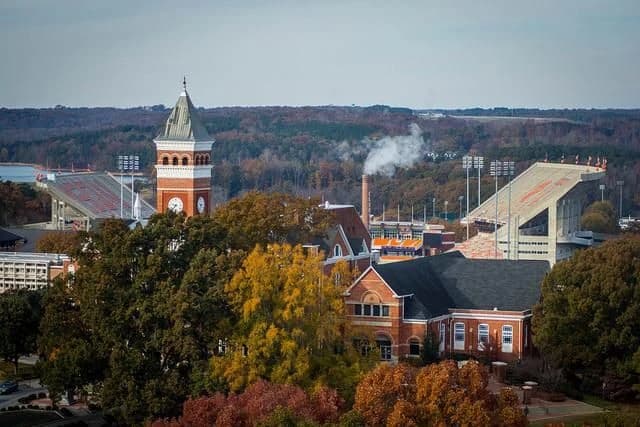
Clemson University is a public land-grant research university located in Clemson, South Carolina. Founded in 1889, it was established as Clemson Agricultural College before becoming Clemson University in 1964. The institution offers a broad range of undergraduate, graduate, and professional programs across colleges including engineering, business, education, agriculture, science, and the arts. Clemson is recognized for its emphasis on research, innovation, and public service, consistent with its land-grant mission. Its campus sits on the former Fort Hill plantation of John C. Calhoun. Students drawn to Clemson University often seek strong programs in engineering, business, agriculture, and the sciences, along with an active campus community and participation in NCAA Division I athletics.
Admission Requirements
With a 38.34% acceptance rate, Clemson University is selective. Admitted students usually have strong academic records, competitive test scores, and consistent involvement in extracurricular activities. While admission is competitive, applicants who demonstrate solid academic preparation and clear interests have a realistic chance of admission.
Cost & Financial Aid
History
Clemson University was founded in 1889 after Thomas Green Clemson bequeathed his Fort Hill estate to the state of South Carolina to establish a public agricultural college. The institution opened in 1893 as Clemson Agricultural College, reflecting its land-grant mission to provide practical education in agriculture and mechanical arts. Henry Aubrey Strode served as the first president, guiding the early development of the campus and curriculum. In the early twentieth century, Clemson expanded its academic offerings beyond agriculture and engineering. During the mid-twentieth century, enrollment grew significantly, and in 1964 the institution was officially renamed Clemson University to reflect its broader academic scope. Since then, Clemson University has developed into a comprehensive research university in Clemson, South Carolina, adding new colleges, research initiatives, and graduate programs while maintaining its land-grant heritage.
Campus life
Gender
Race & ethnicity
Clemson University has a 16:1 student-to-faculty ratio, providing a balance between personalized instruction and a broader classroom environment. Students can expect opportunities to engage with professors while also benefiting from diverse perspectives in class discussions.
Applying to Clemson University with Unive
Applying to Clemson University involves submitting an online application, academic transcripts, standardized test scores if required, and supporting materials such as essays. Clemson University reviews applicants holistically, considering academic performance, course rigor, extracurricular involvement, and personal qualities. Prospective students should review specific college or major requirements and application deadlines to ensure a complete submission.
Financial Aid at Clemson University
Clemson University offers a range of financial aid options, including merit-based scholarships, need-based grants, federal aid programs, work-study opportunities, and student loans. In-state and out-of-state tuition rates differ, and students are encouraged to complete the FAFSA to determine eligibility for federal and state assistance. Clemson University also provides information about departmental scholarships and payment plans to help families manage costs.
Build a Stronger Application with Unive
Unive supports students applying to Clemson University by offering AI-powered guidance for essays, extracurricular strategy, and overall application positioning. Students can refine personal statements, identify meaningful activities to highlight, and discover financial aid opportunities that align with their goals. With structured feedback and planning tools, Unive helps applicants present a clear and compelling application to Clemson University.
Ready to Apply to Clemson University?
Join thousands of students using Unive to craft standout applications for their dream schools.
Add to My College List


Is the information about Clemson University accurate and helpful?