Hartwick College 2026: Acceptance Rate, Cost & Worth It?
Aug 14, 2026
15 min read
If you're building a college list and Hartwick keeps showing up next to words like "transparent tuition" and "3-year degree," you probably have questions the ranking sites answer inconsistently. This guide pulls the numbers together, flags where sources disagree (the acceptance rate is a mess), decodes the 2025 tuition reset in plain English, and gives you an honest verdict on whether it belongs on your list.
Hartwick College at a Glance (2026)
Hartwick College is a small private, not-for-profit liberal arts college in Oneonta, New York, founded in 1797, enrolling roughly 1,097 students with a 9:1 student-faculty ratio. It's best known for nursing, business, and psychology, sits in the Catskill foothills, and made news in 2025 by cutting its published tuition sharply to a "transparent pricing" model.
Fast facts
| Item | Detail |
|---|---|
| Location | Oneonta, New York (Otsego County, Catskill foothills) |
| Founded | 1797 (Hartwick Seminary lineage) |
| Type | Private, not-for-profit liberal arts college |
| Enrollment | ~1,097 undergraduates (fall 2024, US News) |
| Student-faculty ratio | 9:1 |
| Acceptance rate | ~60%–70% depending on source and year (see reconciliation below) |
| Test policy | Test-optional |
| Deadline | Rolling admissions |
| 2026-27 tuition | $23,500 (plus up to $10,000 scholarships), per Hartwick |
| Room & board | ~$16,500 |
| Signature programs | Nursing, FlightPath curriculum, J-Term, 3-year degree option |
| Athletics | NCAA Division III Hawks, 21 teams |
| US News rank | #151 National Liberal Arts Colleges; strong social mobility placement |
Who Hartwick is a good fit for
Hartwick tends to suit students who want small classes, close faculty relationships, and a defined program (nursing and business lead the list) over a big-name brand or a large campus scene. Cost-conscious and first-generation families are a natural audience because of the low published price and social-mobility record. Students who prize a large Greek scene, a city, or lots of anonymity may find it too small and too rural.
Hartwick College Acceptance Rate & Admissions Requirements
Hartwick College's acceptance rate is roughly 60% to 70%, depending on which source and reporting year you read, which makes it a broadly accessible school rather than a highly selective one. US News reports about 69%, College Board's BigFuture has listed closer to 59.7%, and student-review sites like Niche cite around 70%. The spread comes from different data years and admissions cycles, not from one "true" hidden number.
Why sources report different acceptance rates
Colleges report admissions data to the federal IPEDS system once a year, and third-party sites pull that data on different schedules. A profile showing 59.7% and one showing 70% may simply reflect two different entering classes. Test-optional policies also shift the applicant pool year to year, which nudges the rate around.
Here is how the major sources line up.
| Source | Reported acceptance rate | Likely data basis |
|---|---|---|
| US News Best Colleges | ~69% | Recent IPEDS-reported cycle |
| College Board BigFuture | ~59.7% | An IPEDS/Scorecard reporting year |
| Niche | ~70% | Aggregated federal data |
| EduRank / CollegeRaptor | ~70% | IPEDS pull |
The honest takeaway: treat Hartwick as a school where a solid but non-perfect applicant has a genuine shot. Don't over-index on any single decimal. If you want to see how selectivity ranges compare across schools, our free 600+ school college database puts these numbers side by side.
SAT/ACT ranges and test-optional policy
Hartwick is test-optional, so you can apply without submitting scores. For students who do submit, the middle-50% SAT range runs roughly 1070 to 1290, and reported ACT ranges land in the mid-20s. Because the school is test-optional, scores near or above that middle range help but are not required, and a strong GPA and transcript carry the application.
GPA, deadlines, and application requirements
Hartwick uses rolling admissions, meaning applications are reviewed as they arrive rather than by one hard cutoff. That rewards applying early, when more scholarship money and housing are available. A commonly cited average GPA sits around 3.5, though that figure comes from a single source and should be treated as a ballpark. Standard requirements include the application, transcript, and (typically) a recommendation and short writing; TOEFL is used for non-native English speakers, and a GED is accepted.
Your admissions odds: how to read the numbers
With a ~60%–70% admit rate and a test-optional path, Hartwick functions as a target or likely school for many applicants near that GPA and score band. Apply early in the rolling cycle, keep your transcript strong, and use the essay to show fit. For a wider strategy, our guide on how admissions officers read essays explains what actually moves a file.
Tuition, Cost & Financial Aid: The Transparent Pricing Story
For 2026-27, Hartwick College lists tuition around $23,500 with scholarships of up to $10,000, plus roughly $16,500 for room and board, per the official tuition and aid page. That published price is dramatically lower than it was before 2025, when Hartwick reset its sticker price under a "transparent pricing" model.

Why Hartwick cut its sticker price in 2025
Before the reset, Hartwick's published tuition sat in the high-$50,000s, then got heavily discounted with aid, a common private-college pattern. In 2025 the college slashed the published number to around $22,000 to make the real cost obvious up front, a shift covered by higher-ed outlets including Higher Ed Dive and BestColleges. The idea: stop scaring families with a big sticker number they'd never actually pay.
Sticker price vs. net price explained
Sticker price is the published cost before aid. Net price is what a family actually pays after grants and scholarships. Under the old high-discount model, private colleges nationally discounted tuition for first-year students by roughly half or more, according to NACUBO's annual tuition discounting study. Hartwick's reset compresses that gap so the published number is much closer to reality.
Reporting around the reset cited an average net tuition near $13,500. Treat that as a reported figure, not a promise; your number depends on your aid. Always run the net price calculator on the official site for your own estimate. Once you have offers from several schools, our step-by-step guide to comparing financial aid packages helps you read them apples-to-apples.
The Life Balance Credit and other aid
Hartwick's "Life Balance College" positioning includes a Life Balance Credit (reported around $250 per semester) tied to its wellness focus. Beyond that, aid comes from merit scholarships, need-based grants via the FAFSA (which now calculates a Student Aid Index), and, for New York residents, state programs like TAP. Institutional merit awards are where the "up to $10,000" scholarship language applies.
How Hartwick compares to typical private-college discounting
Most private colleges keep a high sticker price and lean on big discounts, which makes true cost hard to see until an offer arrives. Hartwick's model does the opposite: a low published price with a smaller discount. For families who hate the guessing game, that transparency is the point. Also look into outside money; our complete grants for college guide covers sources beyond institutional aid.
Keep every application deadline straight
Unive's Application Roadmap tracks your ED, EA, RD and financial-aid dates in one place, so a date conflict never costs you a cycle.
Get startedAcademics: Majors, FlightPath & J-Term
Hartwick offers 60+ majors, with nursing, business, and psychology among the most popular, all built around a signature curriculum called FlightPath and a January travel term known as J-Term. The 4-1-4 academic calendar and 9:1 ratio mean small classes and hands-on advising are core to how the college teaches.
60+ majors and popular programs
Beyond nursing and business, Hartwick offers strengths in the sciences, psychology, education, and the arts. Because it's a liberal arts college, most programs pair a major with broad general education. If you're still deciding a direction, our breakdown of college majors and how to choose one is a good starting point.
FlightPath curriculum explained
FlightPath is Hartwick's academic and advising framework that ties coursework to career and personal goals, encouraging students to connect classes, internships, and experiences into a coherent path. In practice it means structured advising and an emphasis on applying learning outside the classroom rather than collecting credits in isolation.
J-Term travel courses
J-Term (January Term) is a short intensive session between fall and spring where students take a single immersive course, often a faculty-led travel program. It's one of Hartwick's most-cited features because it lets students study a focused topic or go abroad without a full semester away.
Study abroad and experiential learning
Alongside J-Term, Hartwick supports semester study abroad, internships, and research. The small scale means students can reach faculty for these opportunities more easily than at a large university, a point that shows up repeatedly in student reviews.
Spotlight: Hartwick Nursing Program
Hartwick's nursing program is CCNE-accredited with a history dating to World War II, offering a traditional four-year BSN and an accelerated path, plus simulation labs and clinical placements. Nursing is consistently the college's most popular major and a major reason students choose Hartwick.
CCNE accreditation and history
Accreditation matters for nursing because it affects licensure and employer recognition. Hartwick's baccalaureate nursing program is accredited by the Commission on Collegiate Nursing Education (CCNE). The program's roots stretch back more than 80 years, giving it deep clinical and community ties in the region.
Four-year vs. three-year accelerated paths
Hartwick promotes a three-year bachelor's option that can apply to eligible programs, including a faster route into nursing for prepared students. The accelerated path compresses the timeline, saving a year of tuition and living costs, but it's demanding and not right for everyone. Confirm current eligibility, prerequisites, and clinical sequencing directly with the department.
Clinical experience and requirements
Nursing students move through classroom science, simulation labs, and supervised clinical rotations. Programs like Hartwick's typically enforce GPA thresholds (a 3.0 is a commonly cited transfer benchmark) and progression standards in nursing coursework. Because these rules change, verify the exact GPA and prerequisite requirements on the official nursing pages before you plan a transfer or accelerated timeline.
Career outcomes and licensure notes
A BSN prepares graduates to sit for the NCLEX-RN licensure exam, the standard step to becoming a registered nurse. Hartwick's clinical partnerships and simulation training aim to support that transition. Ask the department for current NCLEX pass rates and employment data, which are the most concrete outcome measures for any nursing program.
Get feedback on your supplemental essays in real-time
Unive.ai helps you improve your writing with instant, personalized feedback on your essays.
Get startedCampus Life, Location & Athletics
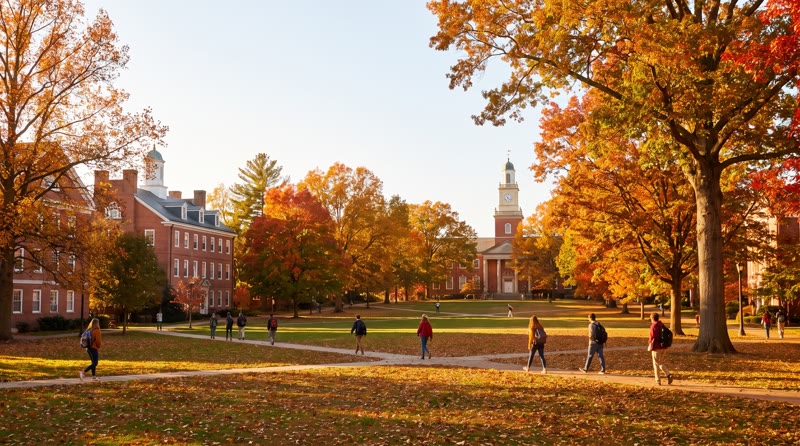
Hartwick sits "on a hill" above Oneonta, a small college town in central New York shared with SUNY Oneonta. The setting is scenic and rural, with the Catskills nearby. That means outdoor access and a tight community, but also isolation for students who want a big-city pace or lots of off-campus options.
Clubs, Greek life, and the Hawks
Hartwick reports 120+ student clubs and organizations, so most students find a group. Greek life exists but is modest and debated among students rather than dominant. Athletically, Hartwick competes as the NCAA Division III Hawks across 21 teams, so sports are participation-driven rather than scholarship-driven, which shapes campus social life.
Life Balance positioning and wellness
Hartwick brands itself as "The Life Balance College," leaning into wellness, mental health resources, and the Life Balance Credit. It's a genuine differentiator in messaging, aimed at students who want a supportive, less pressure-cooker environment. As with any pitch, weigh it against real student reviews rather than the brochure alone.
Is Hartwick College Worth It? Honest Pros & Cons
Hartwick is worth it for students who value small classes, close faculty support, and a strong nursing or business program at a genuinely low published price, but the small, rural setting and mixed reviews on food and facilities mean it isn't for everyone. The transparent pricing makes the value math clearer than at most private colleges.
What students praise
Reviews on sites like Niche and Princeton Review consistently highlight supportive professors, small classes, a close-knit community, and the sense that "everyone belongs to something." Nursing and business get specific praise. Students who want to be known by name, not lost in a lecture hall, tend to like it.
Common complaints
The honest downsides show up too: complaints about dining quality and some aging facilities, a social scene that can feel cliquish or isolating for non-athletes, and a freshman retention rate around 69%, which is below top liberal arts colleges and worth asking admissions about directly. Retention that isn't higher usually signals fit issues for some students, not a single fixable flaw.
Who should (and shouldn't) apply
Strong fits: nursing and business students, first-gen and cost-conscious families drawn to the low net price, and students who want mentorship and a calm, wellness-focused environment. Weaker fits: students who need a large campus, a big Greek or party scene, a city, or a highly ranked national brand for their career plans.
ROI verdict for cost-conscious families
Because Hartwick's published price is low and its social-mobility record is a bright spot, the return on investment can be strong for students who graduate into fields like nursing. The key is running your own net price and comparing it against other offers before deciding. If a private counselor isn't in the budget, our breakdown of college consulting costs shows what you'd otherwise pay for this kind of analysis.
How to Strengthen Your Hartwick Application
Rolling admissions rewards preparation and timing. A clean transcript, an essay that shows genuine fit with Hartwick's small, supportive culture, and an early submission put you in the best position for admission and scholarship dollars.
Build a balanced list around Hartwick
With a ~60%–70% admit rate, Hartwick likely sits in the target/likely zone for many applicants. Pair it with a reach or two and a safety, and consider other under-the-radar schools; our roundup of hidden gem colleges for 2026 is a useful place to find comparables.
Essays and profile tips for rolling admissions
Even at accessible schools, the essay is where you show you understand the college. Reference FlightPath, J-Term, or nursing specifics rather than generic praise. For prompt-by-prompt help, see our breakdown of the Common App essay prompts with real examples.
How Unive helps you plan, write, and apply
Unive is an AI college admissions platform built by Yale graduates that puts deadline tracking, essay feedback, scholarship matching, profile evaluation, and college-list building in one workspace. If you're weighing Hartwick against other schools, our tools can score your essay against admissions standards, match you to scholarships, and map your rolling-admissions timeline so nothing slips.
Unive is a paid subscription with a 7-day money-back guarantee (no free tier), so you can try the full workflow risk-free. Start your college list and essay work at unive.ai.
FAQ
What is Hartwick College's acceptance rate?
Hartwick College's acceptance rate is roughly 60% to 70% depending on the source and reporting year. US News reports about 69%, College Board's BigFuture has listed around 59.7%, and Niche cites near 70%. The range reflects different data years, so treat Hartwick as broadly accessible rather than highly selective.
Why do sources report different acceptance rates for Hartwick?
Sources differ because colleges report admissions data to the federal IPEDS system annually, and sites like US News, BigFuture, and Niche pull that data on different schedules. A profile showing 59.7% may reflect a different entering class than one showing 70%. Test-optional policies also shift the applicant pool year to year.
How much does Hartwick College cost in 2026-27?
For 2026-27, Hartwick lists tuition around $23,500 with scholarships of up to $10,000, plus roughly $16,500 for room and board, per the official tuition page. This published price is much lower than before 2025, when Hartwick reset its sticker price under a transparent pricing model. Always run the net price calculator for your own estimate.
Why did Hartwick College lower its tuition?
Hartwick cut its published tuition in 2025 (from the high-$50,000s to around $22,000) to make the real cost obvious up front instead of relying on large hidden discounts. Higher-ed outlets covered it as a shift to a low-price, low-discount "transparent pricing" model aimed at families put off by high sticker numbers they'd never actually pay.
What is the net price of Hartwick College?
Reporting around the 2025 tuition reset cited an average net tuition near $13,500, but that is a reported figure, not a guarantee. Your actual net price depends on your financial aid, merit scholarships, and residency. Use Hartwick's official net price calculator to estimate what your family would truly pay.
Is Hartwick College test-optional?
Yes, Hartwick College is test-optional, so you can apply without submitting SAT or ACT scores. For students who do submit, the middle-50% SAT range runs roughly 1070 to 1290. A strong GPA and transcript carry more weight, and scores near or above that band can help but are not required.
Is Hartwick College's nursing program good?
Hartwick's nursing program is CCNE-accredited with roots dating to World War II, and it's the college's most popular major. It offers simulation labs, clinical placements, and both traditional four-year and accelerated paths. Ask the department for current NCLEX pass rates and employment outcomes, which are the clearest measures of program quality.
Can you finish a nursing degree in 3 years at Hartwick?
Hartwick promotes a three-year bachelor's option that can apply to eligible programs, including a faster route into nursing for prepared students. It compresses the timeline and saves a year of costs but is demanding and not right for everyone. Confirm current eligibility, prerequisites, and clinical sequencing directly with the nursing department.
What is FlightPath at Hartwick?
FlightPath is Hartwick's academic and advising framework that ties coursework to career and personal goals, helping students connect classes, internships, and experiences into a coherent plan. In practice it means structured advising and an emphasis on applying learning through real experiences rather than collecting credits in isolation.
Where is Hartwick College located?
Hartwick College is in Oneonta, New York, a small college town in Otsego County in the Catskill foothills. The campus sits on a hill above the town, which it shares with SUNY Oneonta. The setting is scenic and rural, offering outdoor access and a close community but limited big-city options.
Is Hartwick College worth the money?
Hartwick is worth it for students who value small classes, faculty support, and strong nursing or business programs at a genuinely low published price, especially cost-conscious and first-gen families. It's a weaker fit for those wanting a large campus, big Greek scene, a city, or a top national brand. Run your net price and compare offers before deciding.
Read next


Jonas

Jonas is the CEO at Unive. Unive students were accepted at 3.48x the average rate and won $35.8M in extra scholarships in 2025. 93% of Unive students get into one of their top 5 college choices.
See more