College Essay Grader: Score Your Essay Like an Officer
Aug 12, 2026
15 min read
You wrote the essay. It reads fine. But "fine" doesn't get you into a top-30 school, and you have no idea whether an admissions reader would feel anything reading it. A college essay grader closes that gap. It scores your draft on the dimensions readers actually weigh, flags the weak spots, and tells you what to fix before the deadline. This page shows you how those tools work, hands you a free self-scoring scorecard, compares the real options, and explains where AI helps and where it fails.
What is a college essay grader (and what it actually scores)
A college essay grader is a tool that reads your admissions essay and returns a score plus specific feedback, judging it against the criteria an admissions reader uses rather than against grammar alone. The strongest ones score storytelling qualities: voice, concrete detail, emotional stakes, reflection, and narrative structure. A polished, error-free essay can still score poorly if it says nothing memorable.
That distinction matters because most students confuse a clean essay with a strong one. Admissions offices practice holistic review, meaning they read your essay as a window into who you are, not a grammar quiz. The National Association for College Admission Counseling (NACAC) documents how essays sit alongside grades, rigor, and activities in that holistic read.
Rule-based checks vs AI rubric scoring
Two engines do the work, and knowing the difference tells you what to trust. Rule-based checks are mechanical: spelling, grammar, passive voice, sentence length, word count. They're reliable because the rules are fixed. General academic graders like Paper Rater live mostly here.
AI rubric scoring uses a large language model to judge softer qualities, whether a moment feels real, whether reflection lands, whether the arc pays off. This is where admissions graders earn their keep, and also where they get shakier, since "good voice" is harder to score than a comma splice. The best tools combine both: mechanics as a baseline layer, rubric scoring on top.
The 5 dimensions admissions readers weigh: voice, specificity, stakes, reflection, arc
Across serious admissions graders, five dimensions come up again and again. Voice is whether the essay sounds like a real 17-year-old and not a thesaurus. Specificity is concrete detail over generic claims (the smell of the clinic, not "I love helping people"). Stakes is what was actually on the line for you. Reflection is what you learned or how you changed. Arc is whether the piece moves somewhere instead of listing.
We map these into a scorecard below so you can score each one yourself.
Why '100/100 grammar' does not equal a strong admissions essay
Here's the trap. A grammar tool can hand your essay a perfect mechanics score while an admissions reader sets it down bored. Reporters who fed generic AI-written admissions essays to former officers found the writing clean but hollow, the kind of draft that reads competent and forgettable at selective schools, as Business Insider's test with admissions experts showed. Grammar is table stakes. The story is the score that counts.
How to grade your own essay before you submit (5-step workflow)
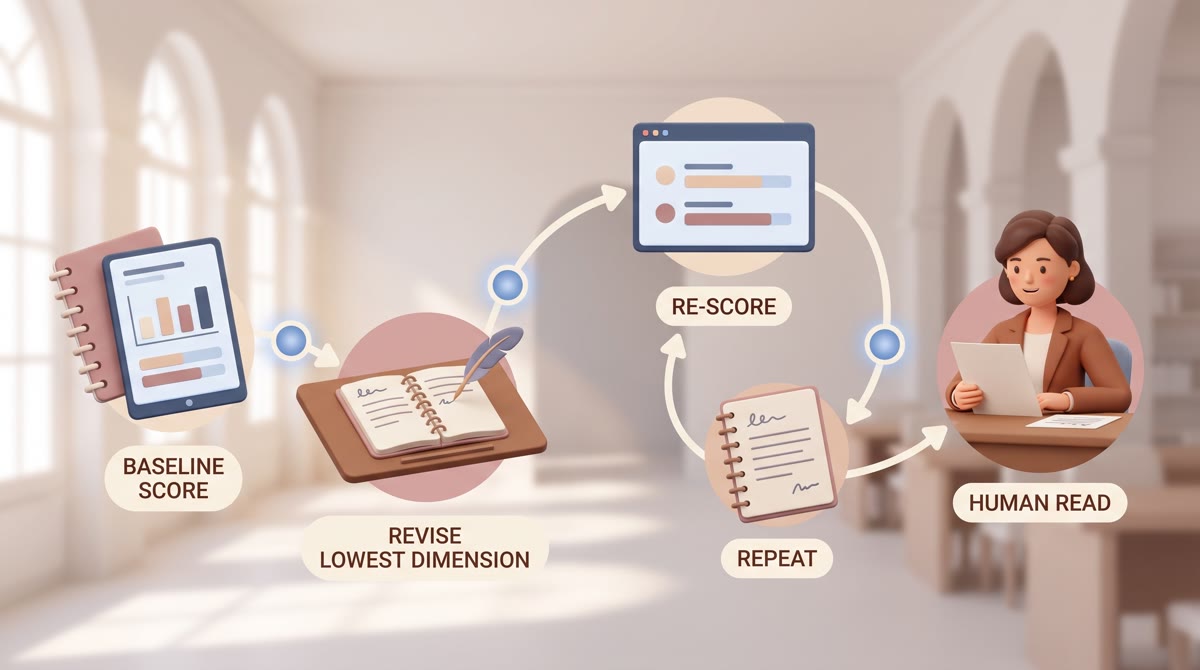
To grade your own essay, run a baseline score on a clean draft, note the lowest-scoring dimension, revise that one dimension only, then re-score and repeat until scores rise, and finish with a human read for voice. This baseline-revise-refine loop beats endless untargeted tinkering because it forces you to fix the weakest link first instead of polishing what's already strong.
Step 1: Baseline score a clean draft
Don't grade a rough first draft. Fix obvious typos and finish your thoughts, then score it. A baseline on a messy draft tells you the draft is messy, which you already knew. You want a read on the writing, not the noise.
Step 2: Note rubric scores and flagged weak spots
Write down the number for each dimension. If a grader gives you voice 4, specificity 2, reflection 2, arc 3, you now know exactly where the essay is thin. Copy the specific flagged sentences somewhere you can see them.
Step 3: Revise the lowest-scoring dimension first
Attack the weakest dimension only. If specificity scored lowest, go replace two abstract sentences with one concrete scene. Resist the urge to rewrite everything at once, because then you can't tell what actually helped.
Step 4: Re-score and track change across drafts
Run it again. Did specificity climb from 2 to 4? Did anything drop? Keep a simple table across drafts so you can see momentum and catch a revision that fixed one thing and broke another.
| Dimension | Draft 1 | Draft 2 | Draft 3 |
|---|---|---|---|
| Voice | 4 | 4 | 5 |
| Specificity | 2 | 4 | 4 |
| Stakes | 3 | 3 | 4 |
| Reflection | 2 | 4 | 5 |
| Arc | 3 | 4 | 4 |
Step 5: Get a human read for voice and nuance
Stop before you over-optimize. AI can tell you reflection is thin; it's less reliable on whether an unusual creative choice is brilliant or broken. A mentor who reads for admissions, ideally someone who has sat on the other side of the desk, catches nuance a rubric misses. That's the read that protects your voice from being sanded into generic "good essay" mush.
The Admissions Reader Scorecard (self-score, 1 to 5)
Use this even with no tool. Score each 1 (absent) to 5 (strong), then act on the lowest.
| Dimension | Ask yourself | If it scores low, do this |
|---|---|---|
| Voice | Does this sound like me talking, not an essay? | Read it aloud; cut any sentence you'd never say |
| Specificity | Are there concrete, named details? | Replace one abstraction with one real scene |
| Stakes | Is it clear what was at risk for me? | Add the tension: what could have gone wrong |
| Reflection | Do I show what changed in me? | Add one honest "what I now understand" line |
| Arc | Does the essay move somewhere? | Cut list-like paragraphs; build one thread |
AI essay grader vs. a $4,000 to $7,000 human consultant
An AI essay grader gives you instant, repeatable scoring and revision feedback around the clock, at a fraction of the cost of a private consultant. A human adds relationship, deep voice judgment, and help with complex situations. Private admissions consultants commonly charge thousands, with comprehensive packages running well into five figures, per reporting on the independent consultant market from Education Week. The strongest setup is both: AI for volume and speed, a human for the calls a rubric can't make.
What AI does as well or faster
AI wins on cycles. You can score a draft, revise, and re-score ten times in an afternoon at 2 a.m., with no scheduling and no per-hour meter running. For the repetitive work of tightening specificity or catching a flat opening, AI feedback is fast, consistent, and available when inspiration hits.
What only a human adds
A person who knows you can push you toward the story you're avoiding. Humans read voice with more nuance, handle sensitive topics with care, and navigate weird edge cases (a gap year, a family crisis, a non-linear path) that a rubric flattens. Relationship and judgment are the human premium.
The best-of-both model: AI grading plus top-school mentor review
This is where Unive sits by design. You get AI scoring and feedback on structure, clarity, storytelling, authenticity, and impact for the fast revision loop, plus oversight from mentors who graduated from schools like Harvard, Stanford, and MIT for the judgment calls. You pay a subscription instead of $5,000-plus to a solo consultant, and there's a 7-day money-back guarantee if it isn't for you.
Keep every application deadline straight
Unive's Application Roadmap tracks your ED, EA, RD and financial-aid dates in one place, so a date conflict never costs you a cycle.
Get startedHow accurate are AI essay graders, and where they fail
AI essay graders are reliably accurate on mechanics and reasonably good on structure and specificity, but they get less trustworthy on voice, nuance, and unconventional creative choices. Specialized admissions graders outperform general chatbots because they're tuned to admissions criteria instead of trying to please you. Treat any score as strong signal, not verdict, and never let a tool overrule a choice you know is true to you.
Why general chatbots flatter your draft
General chatbots are built to be agreeable, so ask one if your essay is good and it usually says yes. That's the danger. A flattering read gives you false confidence right before a deadline. Specialized graders are designed to give the honest read, the one that stings a little and actually helps.
What specialized admissions rubrics get right
A rubric grounded in admissions guidance knows a personal statement is judged on reflection and voice, not on a five-paragraph structure. Tools that build their rubric from the Common Application's official essay requirements and NACAC data score the things readers actually reward, which is why provenance matters when you pick one.
Limits: nuance, creative choices, context
AI misses context. It can't know that your deliberately fragmented opening mirrors the panic you're describing, and it may score it as a flaw. It doesn't know your school, your background, or the risk you took by being vulnerable. Experts who tested AI-written admissions essays found them competent but generic, exactly the ceiling a rubric alone hits. Use the score, keep your judgment.
Is using an essay grader allowed? AI, ethics, and school policies
Using an AI essay grader for feedback is generally allowed and widely treated like using a tutor or Grammarly, as long as the ideas, story, and final words are yours. Getting scored and revising is help. Having AI write the essay for you crosses the line most schools draw. Always check your target school's published AI and academic-integrity policy, because a few are stricter than others.
What 'help' vs 'writing it for you' means
The honest test: could you defend every sentence as your own thought? Using a grader to learn your reflection is thin, then writing a truer paragraph yourself, is help. Pasting a prompt into a chatbot and submitting its output is not your essay. Feedback improves your work; ghostwriting replaces it.
AI detection and false-flag anxiety
AI detectors are probabilistic, not proof, and they do produce false positives, which is exactly why a genuinely human, specific, personal essay is your best protection. When you write from real detail and real feeling, your essay reads human because it is. Getting feedback on a draft you wrote yourself is very different from generating text, and it leaves your authentic fingerprints all over the page.
Checking your target school's AI policy
Policies vary, so read them. Many universities now publish AI guidance for applicants; find each school's admissions or academic-integrity page and confirm what's permitted before you rely on any tool. When in doubt, use graders for feedback and revision only, and keep the writing yours. Unive is built to operate inside that line: AI feedback plus human mentorship on essays you author.
Get feedback on your supplemental essays in real-time
Unive.ai helps you improve your writing with instant, personalized feedback on your essays.
Get startedGrading each essay type: Common App, supplementals, UC PIQs, Why Us
Different admissions essays are scored on different things, so a good grader calibrates its rubric to the essay type. A Common App personal statement is judged on reflection and voice. A Why Us supplemental is judged on specific fit and school knowledge. A UC Personal Insight Question is judged on directly answering the prompt with evidence. Using a generic rubric on the wrong essay type gives you a misleading score.
Common App personal statement (reflection plus voice, 500 to 650 words)
The personal statement is your identity essay. Readers want to understand who you are and how you think, so reflection and voice carry the most weight. Answer one of the seven official Common App prompts and stay inside the 650-word limit; aim for roughly 500 to 650 words, because full-length usually signals you used the space to go deep.
Supplemental / Why Us (fit plus school knowledge)
A Why Us essay is scored on specificity about that school: named programs, professors, traditions, opportunities you'd actually use. Generic praise ("prestigious, beautiful campus") scores low because it could be about anywhere. A grader tuned for supplementals should reward concrete, school-specific detail and flag interchangeable filler.
UC Personal Insight Questions
UC PIQs are shorter (350 words each) and more direct. They reward clearly answering the exact question with real examples over lyrical storytelling. A grader that applies a personal-statement rubric here will mislead you, since the UC read prizes evidence and directness over arc.
Length and word-count guidance
| Essay type | Word target | Scored heavily on |
|---|---|---|
| Common App personal statement | 500 to 650 (650 max) | Reflection, voice, arc |
| Why Us / supplemental | Prompt-specific, often 100 to 400 | Fit, school-specific detail |
| UC PIQ | Up to 350 each | Directness, evidence |
Check the exact limit on each school's application, and use the space; a 300-word personal statement almost always reads underdeveloped.
How to choose an essay grader (feature checklist)
Choose an essay grader on six things: rubric transparency, honest (non-inflated) scoring, essay-type calibration, privacy and data handling, integration with the rest of your application, and access to human oversight. Price matters, but a cheap tool that flatters you is worse than useless before a deadline. Here's how the common options stack up on the criteria that actually change your outcome.
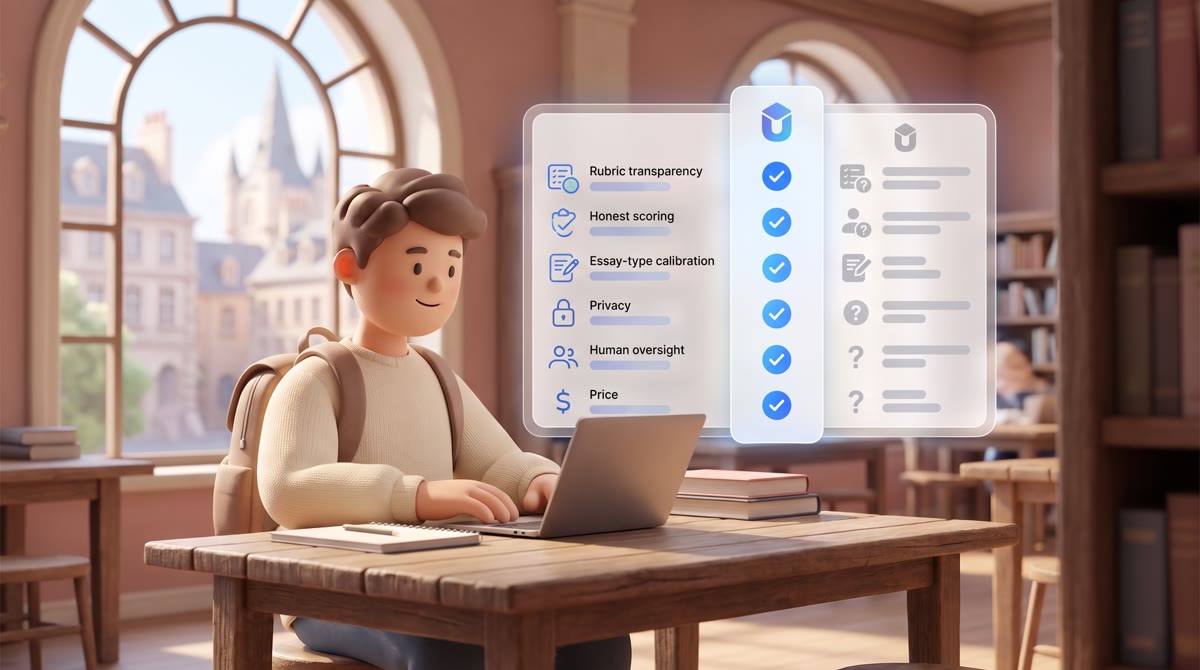
| Criterion | General chatbot | Grammar-first grader | Specialized admissions grader | Unive |
|---|---|---|---|---|
| Rubric transparency | None | Mechanics rules | Often disclosed | Admissions criteria + human oversight |
| Honest vs inflated | Tends to flatter | Neutral mechanics | Honest by design | Honest, admissions-team read |
| Essay-type calibration | Weak | None | Per essay type | Common App, supplemental, Why Us, PIQ |
| Privacy / data handling | Varies | Varies | Some stateless | Account-based, paid platform |
| Integration with application | None | None | Standalone | List, activities, scholarships in one place |
| Human oversight | None | None | Rare | Top-school mentor review |
| Price | Free-ish | Free to low | Free to per-review | Paid subscription, 7-day money-back |
Rubric transparency and sourcing
Ask what the score is based on. Tools that ground their rubric in Common App guidance and NACAC data, and say so, deserve more trust than a black box. Transparency lets you sanity-check whether the tool is even scoring the right things.
Honest vs inflated scoring
You want the read that stings. A tool that never gives low scores isn't protecting your feelings, it's setting you up to submit a weak draft.
Privacy and data handling
Your essay is personal. Check whether drafts are stored, used for training, or discarded, and pick accordingly.
Integration with the rest of your application
An essay score in isolation misses the point. Your essay should complement your activities, your school list, and your scholarship strategy. A tool that sees the whole picture gives better advice than one grading a paragraph in a vacuum. See how Unive stacks up against standalone AI tools.
Human oversight availability
At the top of the funnel of importance is whether a real expert can weigh in. For reach schools, a mentor read is often the difference between competent and admitted.
Grade your essay with Unive (admissions-team-grade feedback)
Unive grades your essay the way an admissions team would, then pairs that AI feedback with human review from graduates of top schools, so you fix the right things before you submit. You get scoring and specific feedback on structure, clarity, storytelling, authenticity, and impact, calibrated to your essay type, inside the same platform that builds your school list, sharpens your activities, and matches you to scholarships. It's a paid subscription with a 7-day money-back guarantee.
Why applicants choose the hybrid model over a $5,000-plus solo consultant: you run unlimited fast revision cycles with AI, and a mentor who has actually read admissions files handles the voice and judgment calls that a rubric can't.
- Fast, honest feedback on the five dimensions that decide your read, not just grammar.
- Human mentor oversight from Harvard, Stanford, and MIT graduates on the calls that matter.
- Whole-application context: your essay is graded next to your list, activities, and scholarship strategy, not in a vacuum.
- 7-day money-back guarantee, so trying it is low risk.
Grade your essay with Unive and get an admissions-team-grade read before your deadline.
FAQ
What is a college essay grader and how does it work?
A college essay grader is a tool that reads your admissions essay and returns a score plus specific feedback, judged against admissions criteria. It combines rule-based checks for grammar and structure with AI rubric scoring for voice, specificity, stakes, reflection, and narrative arc. You paste a draft, choose the essay type, and get an instant report highlighting exactly what to fix.
How do I grade my own college essay before submitting?
Baseline-score a clean draft, note the score for each dimension (voice, specificity, stakes, reflection, arc), then revise the single lowest-scoring dimension first. Re-score, track the change across drafts, and repeat until scores climb. Finish with a human read for voice and nuance, since a rubric can't fully judge unconventional creative choices or context.
Are AI essay graders accurate?
AI essay graders are accurate on mechanics and reasonably reliable on structure and specificity, but weaker on voice, nuance, and unusual creative choices. Specialized admissions graders outperform general chatbots because they're tuned to admissions criteria rather than built to please you. Treat any score as strong signal, not a final verdict, and keep your own judgment.
Is it cheating or against policy to use an AI essay grader for admissions?
Generally no. Using a grader for feedback and revision is treated like using a tutor or Grammarly, as long as the ideas, story, and words stay yours. Having AI write the essay for you crosses the line most schools draw. Check your target school's published AI and academic-integrity policy before relying on any tool.
Will an AI essay grader flag my essay as AI-written?
Grading your own draft for feedback is not the same as generating text, so honest, specific, personal writing reads human because it is. AI detectors are probabilistic and can produce false positives, which is exactly why writing from real detail is your best protection. Getting scored on an essay you authored leaves your authentic fingerprints intact.
Is an AI essay grader as good as a private college consultant?
For fast, repeatable scoring and revision cycles, AI matches or beats a consultant and costs a fraction of the thousands consultants charge. A human adds relationship, deep voice judgment, and help with complex cases. The strongest approach combines both, which is why Unive pairs AI grading with human mentor review from top-school graduates.
How much does a college essay grader cost, and is there a free one?
Some standalone graders offer a free first review; others charge per review or a subscription. Free tools are fine for a quick gut check. Unive is a paid subscription with no free tier and a 7-day money-back guarantee, because it includes human mentor oversight and full-application context, not just a standalone score.
How long should a Common App personal statement be?
The Common App personal statement has a 650-word hard limit, and most strong essays land between 500 and 650 words. Using close to the full length usually signals you developed your story with real depth. A very short personal statement, around 300 words, tends to read underdeveloped to admissions readers.
Why does ChatGPT say my essay is great when I'm not sure it is?
General chatbots are designed to be agreeable, so they flatter drafts by default. That false confidence is dangerous right before a deadline. Specialized admissions graders are built to give the honest, sometimes uncomfortable read that actually improves your essay. Trust a tool that scores you against admissions criteria, not one that always says yes.
Is my essay safe and private when I upload it to a grader?
It depends on the tool. Some graders are stateless and discard your text; others store drafts or use them for training. Always check the privacy policy before uploading. Choose account-based platforms with clear data handling, and avoid pasting your essay into tools that don't disclose what happens to it.
Read next



Ready to improve your draft? Get college essay feedback on hook, clarity, story, and impact before you submit.
Jonas

Jonas is the CEO at Unive. Unive students were accepted at 3.48x the average rate and won $35.8M in extra scholarships in 2025. 93% of Unive students get into one of their top 5 college choices.
See more