AI Essay Writer for College Apps: The Safe Way
Aug 12, 2026
13 min read
You're staring at the Common App prompt. You have a great story somewhere in your head, a deadline in three weeks, and a browser tab open to some "undetectable AI essay writer." You want to know two things: will an AI tool actually help you write a better essay, and will it torch your admission if you use one? This guide answers both, with the actual school policies, the actual detection tools admissions offices use, and a straight framework for using AI without losing your voice or your acceptance.
What an "AI essay writer" actually is (and what it can't do for a college application)
An AI essay writer is a software tool built on a large language model (LLM) that generates, restructures, or edits written text from a user prompt. For college applications, it can help brainstorm topics, outline structure, and give line-level feedback. It cannot supply your lived experience, your specific memories, or the voice an admissions reader is trying to hear.
How LLM-based essay writers work in plain English
An LLM like GPT-4 predicts the next likely word based on patterns from billions of documents. When you ask it to "write a personal statement about resilience," it stitches together the most statistically likely resilience-essay sentences it has seen. That's why generic AI drafts sound eerily similar: they're pulling from the same average of the internet.
Academic essay writer vs. college-application essay writer
Most tools ranked for "AI essay writer" (Jenni, Paperpal, Aithor, MyEssayWriter) are built for academic writing: five-paragraph structure, thesis statements, MLA and APA citations. A college personal statement is the opposite genre. It's narrative, specific, first-person, and voice-driven. Feeding a Common App prompt into an academic essay generator is like using a hammer for a screw.
Where AI genuinely helps
- Brainstorming: dumping 40 possible topics from your activity list so you can pick one
- Outlining: testing 3 competing structures for the same story
- Feedback: identifying vague sentences, cliches, and weak endings
- Proofreading: catching grammar errors and awkward transitions
Where AI hurts
- Voice: it flattens your natural cadence into something smoother and duller
- Vulnerability: it hedges the risky, specific detail that makes an essay memorable
- Specificity: it invents plausible-sounding but generic anecdotes
- Facts: it hallucinates awards, quotes, and details you never actually earned or said
Is it safe to use an AI essay writer on your college application in 2026?
It depends on the school and how you use the tool. Some universities ban AI outright. Others explicitly permit brainstorming and grammar checks but forbid drafting. The Common Application treats AI-generated content submitted as your own work as fraud. Editing and brainstorming with AI is generally safe. Submitting an AI-drafted essay is not.
The Common App rule
The Common Application's fraud policy treats submission of work that is not the applicant's own as a reportable violation, which member colleges can act on with rescinded offers or reported to other schools. AI-generated text presented as your writing falls within this definition unless the school explicitly says otherwise.
The school-by-school patchwork
| School | AI policy stance | What's allowed |
|---|---|---|
| Brown | Restrictive | Discourages AI in application writing |
| Georgetown | Restrictive | Applicants asked not to use AI |
| Caltech | Limited use | Research, brainstorming, grammar OK; drafting, outlining, translation not allowed |
| Cornell | Limited use | Similar posture: assistive only, not generative |
| Harvard | No public prohibition | Voice and authenticity emphasized |
| Stanford | No public prohibition | Original work expected |
| MIT | No public prohibition | Original work expected |
| Virginia Tech | Uses AI in review | Reads essays with both human and AI scoring |
Caltech's first-year application instructions state that "applicants may use AI to do research, pose brainstorming questions, or check grammar and spelling. Applicants may not use AI to outline the essay, draft text, or translate the essay from another language." That's the clearest line any elite school has drawn, and it's a useful default even for schools with no stated policy.
Re-check each school's admissions site before you submit. Policies are being updated mid-cycle.
How admissions offices actually detect AI
Admissions readers are not running your essay through five detectors. But they use tools, and the tools are getting better. The most common:
- Turnitin's AI writing detection, already integrated into most university plagiarism workflows
- GPTZero, used by individual readers and some admissions offices
- Originality.ai and Copyleaks, common in enterprise workflows
- ZeroGPT, popular for spot checks
Beyond software, experienced readers spot AI by tone. Essays that read as smooth, generic, and structurally perfect (opening hook, three tidy body paragraphs, reflective close) stand out. Human writing has what researchers call "burstiness": messy sentence-length variation, tangents, and rhythm shifts.
The Kaplan survey
Kaplan's 2024 admissions officer survey found that a majority of colleges surveyed had no formal AI-essay policy, a significant minority prohibited AI use in essays, and only a small percentage explicitly allowed it. Read the Kaplan admissions survey directly for the exact figures, and assume the numbers shift each cycle.
What Virginia Tech is doing
Virginia Tech has publicly described a holistic review process where essays receive scoring input from both human readers and AI evaluation. It's a preview of where selective admissions is heading: AI on both sides of the table.
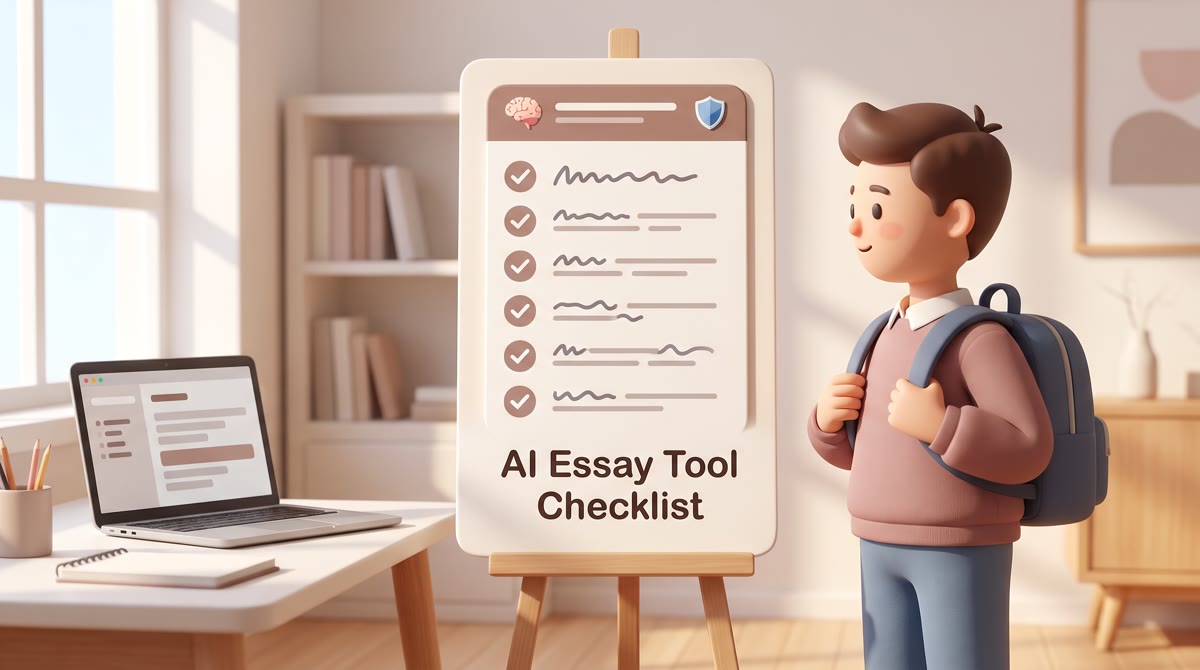
The 7-point evaluation checklist for an admissions-safe AI essay writer
A college-application AI tool needs to be trained on the right data, tuned for personal narrative, and built to keep the draft yours. Most tools ranked for "best AI essay writer" fail at least four of these seven criteria because they were designed for coursework, not admissions.
1. Trained on accepted admissions essays, not just academic writing or general web text. Generic tools optimize for essays that sound like Wikipedia. Admissions essays are the opposite.
2. Personal-statement tone, not academic-formal tone. No thesis statements. No "in conclusion." First person, past tense, specific detail.
3. Prompt-specific mode for Common App and school supplements. "Why This College," "Community," and "Intellectual Vitality" prompts each need different scaffolding.
4. Voice-matching to your existing writing. The tool should read samples you've already written and match your rhythm, not overwrite it.
5. Built-in AI and plagiarism detection before you submit. You should be able to run your finished draft through the same detectors admissions offices use.
6. Human mentor oversight for the high-stakes calls: topic choice, framing, whether a risky detail is powerful or too much.
7. Policy-compliant workflow. The tool should help you brainstorm, outline, and edit without generating the finished draft on your behalf.
Get feedback on your supplemental essays in real-time
Unive.ai helps you improve your writing with instant, personalized feedback on your essays.
Get startedBest AI essay writers for college applications, compared
No single tool is right for every applicant. The right choice depends on your target schools' AI policies, whether you need mentor oversight, and how much of the writing process you actually want AI touching.
| Tool | Built for admissions? | Human mentor | Detection pre-check | Best for |
|---|---|---|---|---|
| Unive | Yes | Yes, top-school grads | Yes | Ivy+/top-50 applicants who want AI plus human review |
| Kolly | Yes | No | Partial | Students benchmarking against T20 accepted essays |
| ESAI | Yes | Coach-guided | No | Story-first coaching, ex-admissions officer design |
| PerfectEssayWriter | Partial (has Personal Statement mode) | No | No | Quick supplement drafts |
| MyEssayWriter / Writeless / NoteGPT | No | No | Marketed "undetectable" | Coursework, not applications |
| ChatGPT (GPT-4/5) | No | No | No | Free brainstorming only |
| Jenni AI / Paperpal | No, academic | No | No | Research papers, dissertations |
Unive: AI admissions team with mentor oversight
Unive is built specifically for undergraduate applicants targeting Ivy League and top-50 universities. It combines an AI essay assistant (brainstorming, outlining, voice-matched feedback) with 1-on-1 mentorship from graduates of top schools. You draft. Unive coaches. A mentor reviews. Every essay gets pre-checked against AI detection tools before you submit, so nothing surprises you.
Kolly
Kolly markets itself as trained on accepted essays from students who got into Stanford, Harvard, MIT, Penn, and other T20 schools, with scoring calibrated against a curated set of accepted examples. Strong for benchmarking, no built-in mentor layer.
ESAI
ESAI was designed by former college advisors and admissions officers with an emphasis on story-first coaching. If you want a tool that pushes you to find your narrative rather than generate one, ESAI is a serious option.
PerfectEssayWriter, MyEssayWriter, Writeless, NoteGPT
These are general essay generators with varying degrees of admissions tuning. PerfectEssayWriter has a dedicated Personal Statement mode. The others are academic-first and use AI-detection-evasion as a selling point, which conflicts with how admissions offices actually evaluate integrity. Use for coursework, not applications.
ChatGPT
Free, powerful, and completely untuned for college admissions. It hallucinates citations, invents anecdotes when pushed, and defaults to a generic, over-smooth voice that admissions readers recognize. Fine for brainstorming lists. Dangerous as a drafter.
Jenni AI and Paperpal
Both are excellent for research papers, coursework, and structured academic writing. Neither is built for personal-narrative college essays.
Why generic AI essay writers (and ChatGPT) fail on college essays
Generic tools were trained to sound correct. College essays need to sound like you. That mismatch shows up in four ways: wrong tone, hallucinated details, detector-friendly rhythm, and no memory of what specific schools actually want.
Academic-formal, not personal-narrative. ChatGPT's default is measured, hedged, five-paragraph. A great personal statement opens on a specific moment, breaks structure on purpose, and ends without a bow on top. The default LLM voice is the opposite of that.
Hallucinated citations and generic anecdotes. Ask ChatGPT to add supporting detail to your essay and it will invent an award you didn't win, a book you didn't read, a mentor who doesn't exist. It doesn't know it's lying. It's predicting plausible-sounding text.
Uniform burstiness. Detectors like GPTZero flag text that has abnormally consistent sentence length and structure. LLM output is naturally uniform because it optimizes for the most probable next token. Human writing lurches, backtracks, and repeats. If your draft reads like every sentence is the same length, a detector will notice.
No knowledge of school supplements. A generic tool doesn't know that Chicago's Uncommon Essays reward genuine weirdness, that Stanford's roommate letter has a specific tone, or that MIT wants you to describe a challenge in exactly 200-250 words. Admissions-tuned tools do.
No feedback loop against accepted essays. Generic tools grade against "good writing." Admissions-tuned tools grade against essays that actually got someone in.
How to use an AI essay writer without losing your voice (or your admission)
The safest workflow uses AI at the edges of the writing process, not in the middle. Brainstorm with it. Outline with it. Get feedback from it. Write the draft yourself. Run the finished piece through detection before you submit.
Step 1: Brainstorm
Feed the AI your activities list, your resume, and 5-10 sentences about memories that still feel loud to you. Ask it for 40 possible topics. Cross out 35. Pick from the 5 that made you nervous.
Step 2: Outline
Ask for three competing structures for the same story: chronological, in medias res, and framed around a single object. Pick the one that lets the specific detail do the work. Never let AI write the opening line.
Step 3: Draft in your own words
Open a blank document. No AI in this tab. Write badly and fast. Aim for 800 words when the limit is 650. You need material to cut.
Step 4: Get line-level feedback
Paste your draft into an admissions-tuned tool. Ask for vague sentences, cliches, and weak transitions. Ask what a reader would remember. Don't ask it to rewrite. Rewrite yourself.
Step 5: Detection pre-check
Before submitting, run your finished draft through the same detectors admissions offices use. If your voice-matched, human-drafted essay flags as AI, something in your rhythm is too uniform. Break sentences. Add a fragment. Trust the mess.
What to never paste into an application
- Fabricated anecdotes an AI generated
- Metaphors an AI wrote for you
- Paragraphs an AI translated from your first language
- "Improved" versions where the AI rewrote whole sections
The personal statement is the one part of your application where the reader gets to hear you unmediated. Don't hand that microphone to a model.
See how your profile reads to an admissions officer
Unive's Profile Evaluator shows how your rigor, scores and activities stack up against a specific college, so you know where you stand before you apply.
Get startedUnive vs. ChatGPT vs. $20K human consultants
A private admissions consultant runs $20,000 to $60,000 for a full package. ChatGPT is free and untuned. Unive sits in between: admissions-specific AI plus mentor oversight, at a subscription price with a 7-day money-back guarantee.
| ChatGPT | $20K Consultant | Unive | |
|---|---|---|---|
| Cost | Free / $20 mo | $20K–$60K | Subscription |
| Trained on admissions | No | N/A | Yes |
| Voice-matching | No | Manual | Yes |
| Human mentor | No | Yes | Yes, top-school grads |
| AI-detection pre-check | No | No | Yes |
| Availability | 24/7 | Scheduled | 24/7 |
| Money-back guarantee | No | Rare | 7 days |
The cost math
A typical private consultant charges $300 to $600 per hour, or $20,000+ for a multi-year package. The value is the hours of feedback, the strategic sequencing, and the pattern recognition from having seen thousands of applications. AI can do a large share of that at a fraction of the price. What AI can't replace is a human who has read your kid's essay three times and knows which sentence to cut.
Where AI still can't replace a human
- The 90-minute voice-discovery interview where a mentor draws out the story you weren't going to tell
- The judgment call on whether a risky topic is powerful or disqualifying
- The read-through the night before submission by someone who has seen a hundred essays get in
Unive's hybrid model
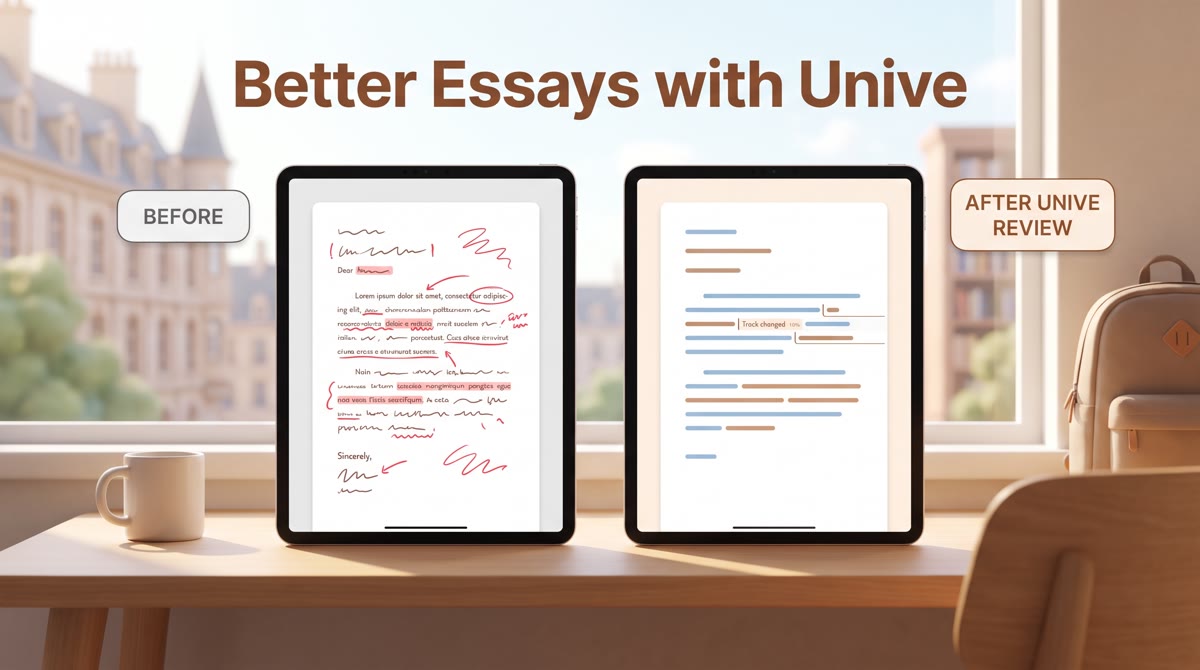
Unive combines an AI essay assistant tuned for admissions with 1-on-1 mentors who graduated from top-tier schools. The AI handles the reps: brainstorming, outlining, line edits, detection checks. Mentors handle the judgment: is this the right story, is this the right framing, is this the version that gets in. See how the platform works or read about the 7-day money-back guarantee. If the platform isn't right for you, you're not stuck.
FAQ: AI essay writers and college admissions
Frequently Asked Questions
Can colleges tell if I used AI to write my essay?
Sometimes yes. Admissions offices increasingly use tools like Turnitin's AI writing detection, GPTZero, Originality.ai, and Copyleaks. Beyond software, experienced readers recognize AI tone: overly smooth sentences, generic anecdotes, and no rhythm variation. Editing with AI is usually undetectable. Submitting an AI-drafted essay is a real risk.
Is using AI to write a college essay cheating?
Using AI to draft an essay you submit as your own work is treated as fraud by the Common Application and by most selective colleges. Using AI to brainstorm topics, outline structure, or check grammar is generally permitted, and some schools like Caltech state this explicitly. Always check each school's admissions page.
What is the best free AI college essay generator?
ChatGPT's free tier is the most capable general LLM, but it's not tuned for admissions and hallucinates details. For actual college applications, free generic tools carry more risk than value. If cost is the concern, a paid admissions-specific platform with a money-back guarantee costs less than one hour of a private consultant.
Can AI write my Common App personal statement?
It can, but you shouldn't submit what it writes. The Common Application's fraud policy treats work submitted as your own that wasn't written by you as a reportable violation. Use AI to brainstorm, outline, and get feedback. Draft the essay yourself.
Will Turnitin flag my essay if I used AI for editing?
Grammar and spelling correction rarely triggers AI detection. Full-paragraph rewrites often do. Turnitin's AI detector looks for statistical patterns in word choice and sentence rhythm. If you kept your draft in your voice and only used AI for line-level feedback and proofreading, flagging is unlikely.
Do Harvard, Stanford, and MIT allow AI in essays?
None of the three has a published prohibition on AI use in application essays, but all three emphasize authentic, original work in the applicant's own voice. Treat their silence as "assistive AI use is tolerated, generated content is not." Caltech's public rule is a safe default: research, brainstorming, and grammar are fine; drafting and translation are not.
How is Unive different from ChatGPT for college essays?
ChatGPT is a general LLM trained on the internet. Unive is an AI admissions platform tuned on admissions-specific patterns, with voice-matching, prompt-specific modes for Common App and school supplements, built-in AI-detection pre-check, and 1-on-1 mentorship from top-school graduates. ChatGPT gives you output. Unive gives you an admissions team.
Ready to write essays that sound like you and get read like you belong?
Unive is the AI admissions platform built for students targeting Ivy+ and top-50 schools who want elite-level essay support without a $20,000 consultant bill. AI drafting help, human mentor oversight, and detection pre-check on every submission. Try it with a 7-day money-back guarantee.
Read next
Ready to improve your draft? Get college essay feedback on hook, clarity, story, and impact before you submit.
Jonas

Jonas is the CEO at Unive. Unive students were accepted at 3.48x the average rate and won $35.8M in extra scholarships in 2025. 93% of Unive students get into one of their top 5 college choices.
See more